

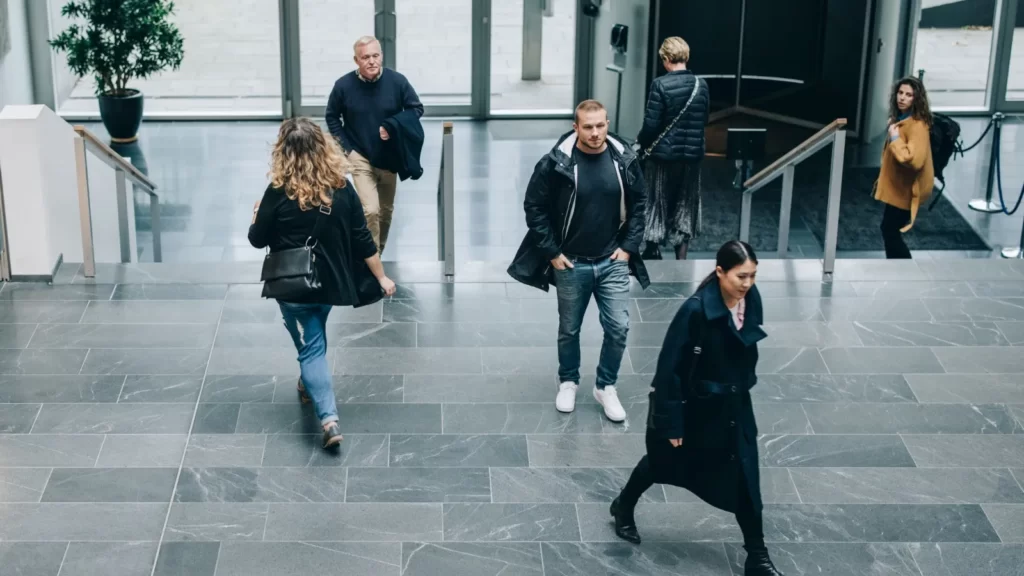
Creating a better workplace for the era of hybrid work is as much about creative space design as it is about leveraging smart building and collaboration technologies. The goal? To keep employees safe, productive, and motivated to return to the office.
Although much of the focus has centered lately on delivering a better experience for remote workers, empowering employees with a compelling in-office experience is essential for rekindling those human connections and the collaborative energy lost during pandemic-era virtual interactions. Presenting a unique experience is also essential for attracting and retaining employees—one hurdle many business leaders face, given the ongoing talent crunch.
In preparation for the return to office and hybrid working models, companies need to rethink their spaces with an eye toward more flexible collaboration, enhanced productivity, and worker safety and well-being. “Singular work can be done anywhere—what we all really miss is connecting,” says Ray Milora, director of Workplace Experience at Cisco. “What’s required is the seamless integration of people, space, and technology. If someone shows up to the office, flips open their laptop, and starts staring at an Excel spreadsheet, then we’ve massively failed.”
The Cisco advantage
Today’s modern hybrid workplaces are trading up individual offices and desks for shared collaboration areas, hot desks, and smart workspaces. IT, HR, and executive teams need to coordinate real estate utilization, optimize for real-time occupancy;, and monitor key environmental elements such as indoor air quality, temperature, and noise levels—across a meeting room, floor, or entire building. At the same time, employees should be able to effortlessly find and reserve empty meeting rooms and available desks, even drilling down to find spaces with desired temperatures or occupancy rates with the touch of a button, on an app, or from shared digital signage.
At the heart of these modern hybrid workspaces is technology—what Cisco describes as the fourth utility driving digital real estate transformation. With telemetry data collected from internet-of-things (IoT) sensors, cameras, and environmental monitoring systems, for example, organizations can measure their real estate outcomes and adjust accordingly. This could mean automatically adjusting air temperature, humidity, lighting, and even blinds to keep employees safe and promote energy and cost efficiencies or to control occupancy rates to avoid overcrowding.
Cisco is making technology the foundation for its own hybrid work environment, the marquee space being Penn 1, its 54,000-square-foot office in New York City. Cisco defined outcomes in areas it needed to measure, including occupancy space utilization, indoor air quality, energy usage, and 92 video endpoints, all while ensuring a better experience for its employees.
Reimagining office life for the hybrid world is not just about technology or redesigned facilities—it’s also about taking an integrated approach that includes enlisting executive champions, redefining business processes, and evolving organizational culture.
“This is not just a facilities exercise or an IT exercise or HR exercise; it’s all three,” Milora says. “If you ignore that, you’re building a cool office building with a bunch of technology in it. That’s all you’re doing.”
Visit to learn more.