

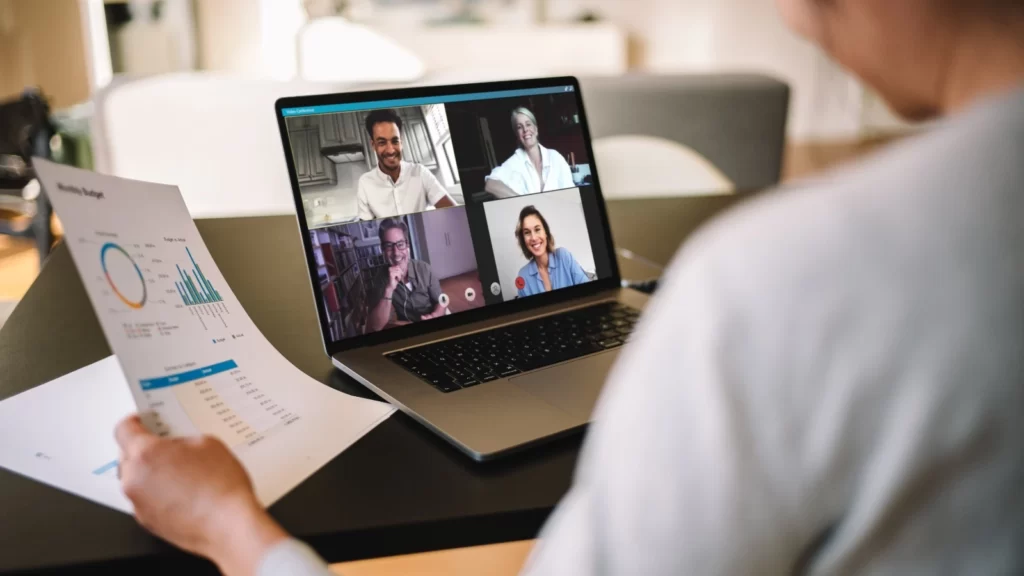
In today’s world, companies and employees are shifting to a new hybrid model of work never seen before. Prompted by the pandemic, leaders are allowing more employees to complete their work from a variety of locations—not just in the office.
Many companies rushed into remote work out of necessity at the start of the pandemic, and some of the solutions and systems they cobbled together aren’t meant for the long term. To be truly successful, CIOs and IT leaders must take a comprehensive, holistic approach to hybrid work, reevaluating and transforming the hasty measures and tools previously put in place. Among the critical issues that need addressing are how to create an inclusive culture and enhance collaboration, solve issues related to cybersecurity, and source the best technology to support a distributed workforce.
“IT leaders need to be ruthless when targeting and remediating their hybrid work debt: the security, technical, and software licensing corners they may have cut to get their workers remote in the early days of the pandemic,” says Will Kelly (@willkelly), a content and product marketing manager focused on the cloud and DevOps.
Global thought leader and tech influencer Elitsa Krumova (@Eli_Krumova) adds that in 2022 tech leaders will succeed if they can foresee what the “new normal” might look like and plan accordingly. “CIOs and IT leaders should be prepared to shift and switch business habits, operations, processes, strategies, and tactics,” she says.
Evolving hybrid into a holistic experience
During the pandemic, the immediate need for remote and then hybrid work models left leaders unprepared to tackle the organizational gaps that soon became evident. Now CIOs and IT leaders need to build a strong foundation on which to plan for the future of work.
IT leaders should prepare a strategic agenda covering all possible scenarios—from the work-from-home organization to permanent remote work or hybrid work, says Krumova. “A disaster recovery and business continuity strategy is a must for every business in 2022.”
As leaders build their strategy, Peter B. Nichol (@PeterBNichol), chief technology officer at OROCA Innovations, says, they should first take the time to identify the expertise and new skills required to excel in a hybrid environment. Then group these skills into business-enabling capabilities. Finally, link capabilities to valuable job competencies for your company.
“Make your company’s strategy clear,” he says. “Develop a new organizational mindset to redefine your employment brand by empowering virtual collaboration. And, finally, measure outcomes over tasks.”
Frank Cutitta (@fcutitta), CEO and founder of HealthTech Decisions Lab, agrees that hybrid work must be looked at holistically, where the technology enhances the work experience. “This takes close collaboration between IT and HR to assure efficacy,” he adds.
A healthy, inclusive culture where employees have a voice
Part of developing a smart, cohesive hybrid work strategy involves enhancing company culture, working toward a culture where all employees feel included, that their health and wellness is top-of-mind, and that their input is truly listened to and valued.
Success in hybrid work has everything to do with a company’s people, stresses Nichol. “You co-create your company’s future state by using hybrid principles to partner with your employees,” he says. “In other words, give your employees a voice in their future.”
Adds Sergey Alyamkin, CEO and cofounder of ENOT.ai, “The key is to create a new culture and technical means for collaboration in the hybrid environment.”
Jack Gold (@jckgld), president and principal analyst at J.Gold Associates, LLC, believes that companies can do a better job of assessing the well-being of employees in the new state of hybrid work. They should monitor employee wellness to make sure hybrid working tools are functioning as expected, employees aren’t getting burned out, and work is being properly dispersed among team members.
“While such monitoring could cause some concern about privacy,” he says, “it’s simple to anonymize the data and protect workers’ privacy while still increasing overall productivity and worker well-being, resulting in a more positive workplace experience and removing the potential for costly lost productivity. Enterprises should be deploying such capability now to better leverage hybrid work,” he adds.
Organizations should also consider the motivation system they have in place, says Nikolay Ganyushkin, CEO and cofounder of Acure. Whereas in a classical work system, people are given instructions and motivated by others, in a hybrid work environment, this doesn’t always
work. “Information technology comes to the rescue,” he says. “My advice is to automate all routine operational processes as much as possible.”
Investing in the right technology
To adapt to the ongoing workplace disruption, CIOs and IT leaders must firmly rely on technologies to help them adapt. Building a secure infrastructure that can support work-from-anywhere and use relevant technologies to assist remote work is critical.
Shail Khiyara (@ShailKhiyara), founder (VOCAL) and operating advisor at Peakspan Capital, says that more than ever, there’s a need for investment in technology to bridge the physical and digital realms, combat digital exhaustion, and seamlessly facilitate asynchronous working while rethinking employee experience and engagement.
Hybrid work doesn’t mean that all an employee needs is a webcam and a Zoom account, adds Ben Rothke (@benrothke), senior information security manager at Tapad.
Instead, “such technologies could include tools for virtual communication, tools for videoconferencing, cloud-based solutions, accessible-from-anywhere online tools for collaboration and project management, and online file sharing platforms,” says Krumova.
Enhancing collaboration and digital know-how in a hybrid world
The best technological tools, however, won’t help transform workplaces without collaborating and teaching employees how to best harness the tools.
The emerging new work models in a post-COVID-19 world require business leaders, IT managers, HR executives, and senior management to ensure that their organization is digitally fluent, says Krumova.
“This could be achieved by organizing internal trainings and programs for skills upgrade and by designing personalized learning and development paths for employees,” she says. “It is crucial to make the relevant resources available to remote workers.”
One goal of training should be to get workers to a point where they’re self-sufficient and where challenges can be seamlessly and efficiently resolved, adds Kelly. For this to work, collaboration between business units and IT is integral.
“The advent of hybrid work is also an excellent time for IT leaders to reconnect with their internal networks of stakeholders and senior employees,” he says. “They should be reaching out to these people proactively and rekindle relationships that may have gone dormant during the pandemic so they can collaborate on resolving hybrid-work challenges.”
The challenges of cybersecurity
While overseeing the current security state of the business infrastructure, CIOs and IT leaders
in 2022 must also anticipate and be prepared for emerging threats in cybersecurity. It’s a “most vital task,” says Krumova.
With these new ways of working with all staff no longer being on-premises all the time and with new tools to facilitate hybrid work, organizations may find themselves increasingly vulnerable to growing cybersecurity threats, making security more important than ever.
These new information security challenges include patching, clean desk policy, endpoint security, and the risk of insider threats, says Ben Rothke (@benrothke), senior information security manager at Tapad.
“The hybrid environment makes maintaining that same level of cybersecurity controls much more of a challenge,” he says. “Research has shown that remote workers pose a greater risk than on-premises workers. Executives must consider these things if they want to succeed in a hybrid work environment.”
To fortify remote or hybrid work, Chuck Brooks (@ChuckDBrooks), president of Brooks Consulting International and an adjunct faculty member at Georgetown University, says first develop and implement a risk management framework.
Next, optimize security in the cloud, which enables implementation of dynamic policies and faster encryption, drives down costs, and provides more transparency for access control (reducing insider threats). Finally, consider encryption, especially putting data files through full pervasive encryption.
“Because of digital transformation, securing data necessitates a hypersecurity focus, and a strategy is an imperative,” he says. This is especially important, since data has become more than a commodity—it’s a driving force that determines how people live, earn, and function as a society. “If you get hacked, you want to keep your data protected,” Brooks adds.
Risk management strategies should include people, processes, and technologies. That includes knowing one’s inventory and gaps, integrating cybersecurity hygiene practices, procuring and orchestrating an appropriate cybertool stack, and having an incident response plan in place if a breach does happen.
As CIOs and IT leaders work toward a more seamless and secure hybrid working future, they should put themselves in the proverbial shoes of their users and work remotely as well, stresses Jason James (@itlinchpin), chief information officer at Net Health.
“This does two things,” he says. “It shows that hybrid work is supported by leadership and allows for continued improvement to hybrid tools and processes. For example, if there are tools that seem cumbersome or difficult to you, then the same is most likely true for your users. Use those pain points to champion and implement more frictionless solutions to allow for greater collaboration and ease of use for those working remotely.”
Visit to learn more.